
Cook in Norwegian!
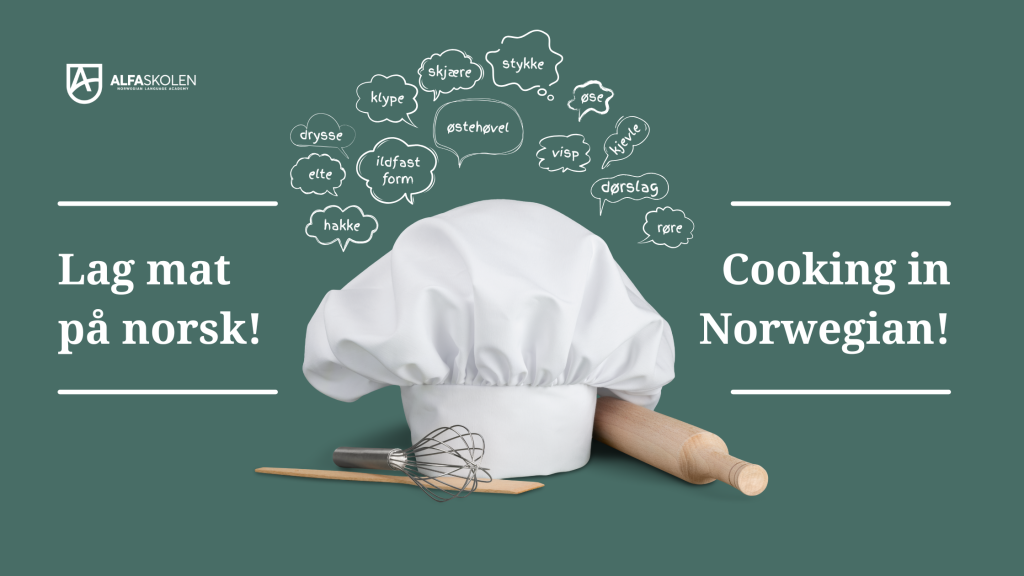
Cooking can be social and fun, and often you can get to know other cultures through cooking. In this short text, we will talk a bit about the Norwegian language used in recipes and some of the verbs that we frequently use in cooking, but may not encounter as often in other situations.
Ingredients and measurements
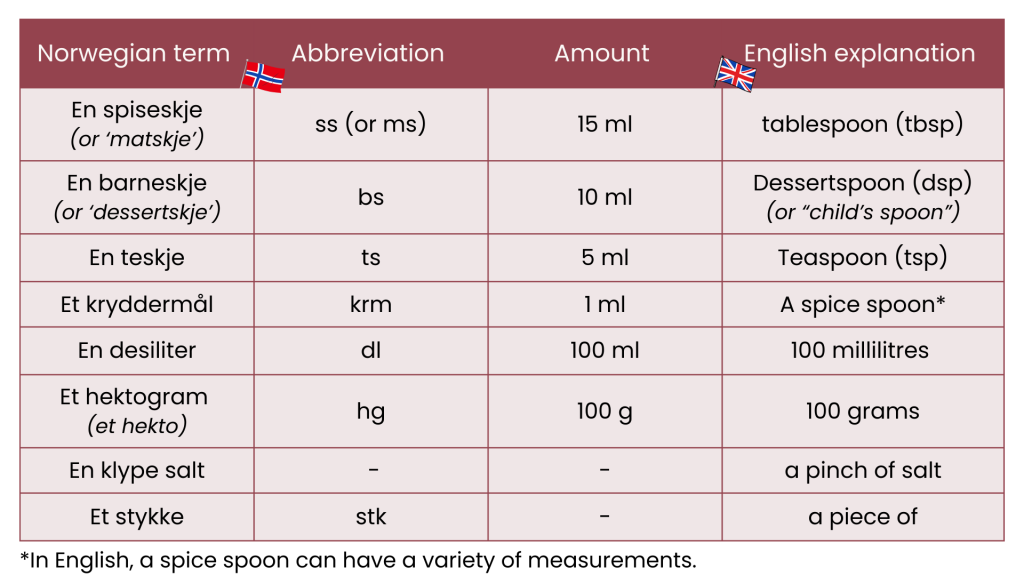
When you look up a recipe, the first thing you usually find is a list of ingredients and how much of each ingredient you need. Already at this stage, you might find it difficult to understand what is meant. For example, what does “2 ts salt” mean? Well, “ts” stands for “teskje” (teaspoon) and is, for most people, the smallest spoon we use in our everyday life. Abbreviations and measurement units that differ from those in other languages can be useful to get an overview of, so we have put together a small list for you here:
Show text version here:
Norwegian term | Abbreviation | Amount | English explanation |
|---|---|---|---|
| En spiseskje (or ‘matskje’) | ss (or ms) | 15 ml | tablespoon (tbsp) |
| En barneskje (or ‘dessertskje’) | bs | 10 ml | Dessertspoon (dsp) (or “child’s spoon”) |
| En teskje | ts | 5 ml | Teaspoon (tsp) |
| Et kryddermål | krm | 1 ml | A spice spoon* |
| En desiliter | dl | 100 ml | 100 millilitres |
| Et hektogram (et hekto) | hg | 100 g | 100 grams |
| En klype salt | – | – | a pinch of salt |
| Et stykke | stk | – | a piece of |
What to do, and how to say it (bending verbs)
We also need to talk a bit about verbs! In recipes, as well as in other instructions, we very often use the imperative form. Do you remember how we form the imperative in Norwegian? The main rule is that we remove the final “e” from the infinitive form (though there are some exceptions).
Example: The infinitive form “å hakke” (to chop/to mince) becomes “hakk” in the imperative:
Finhakk løken og hvitløken. (Finely chop the onion and the garlic.)
If there is no “e” at the end of the infinitive form, the imperative form is identical to the infinitive:
“Å dra” (to pull) becomes “dra” in the imperative as well:
Dra skinnet av torsken. (Pull the skin off the cod.)
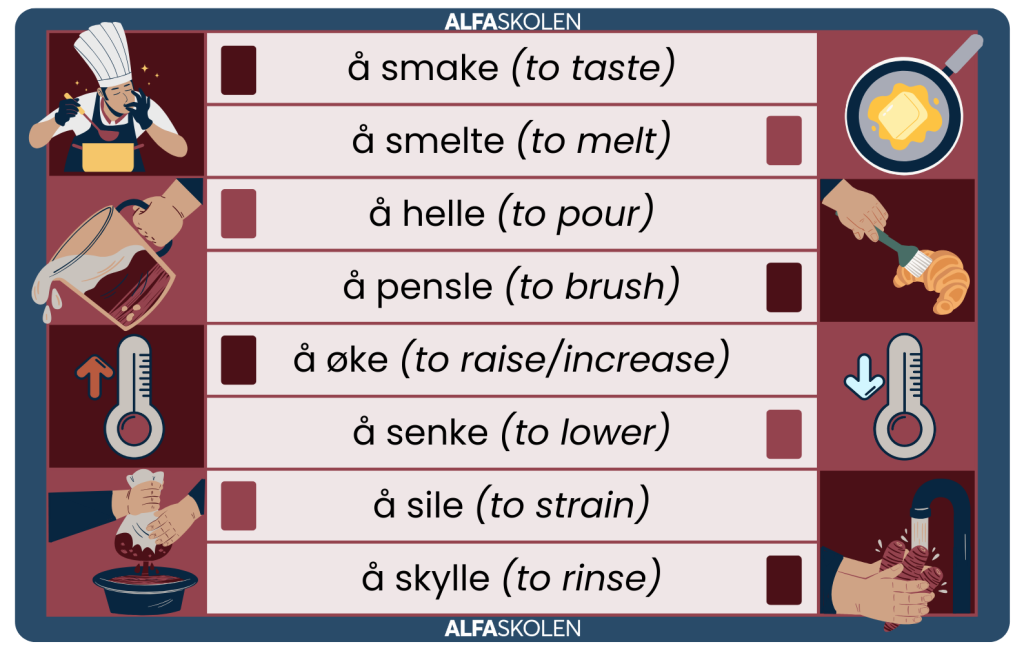
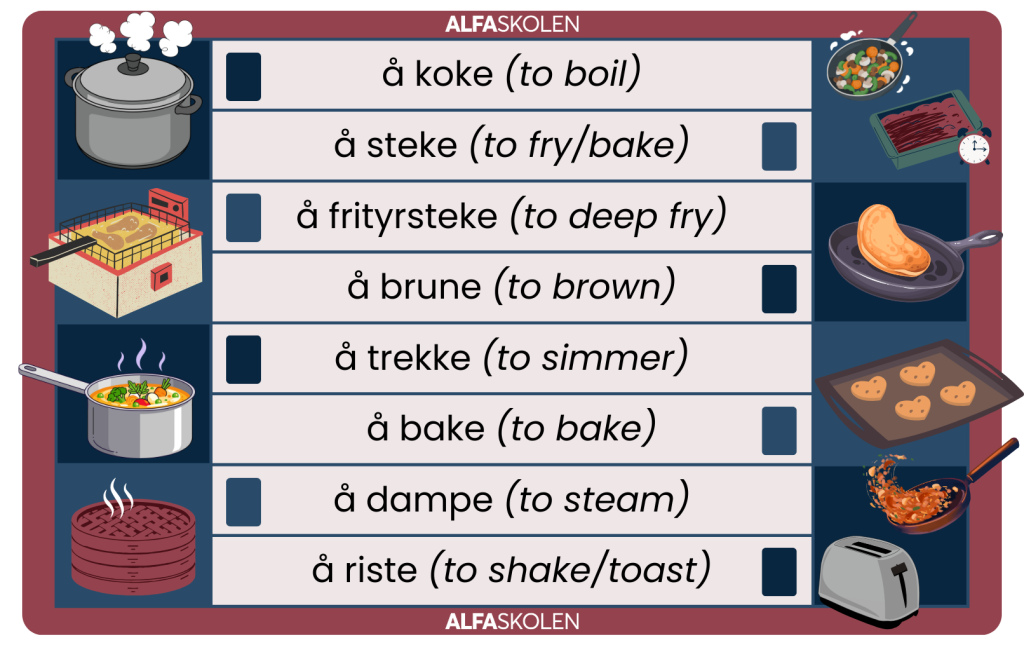
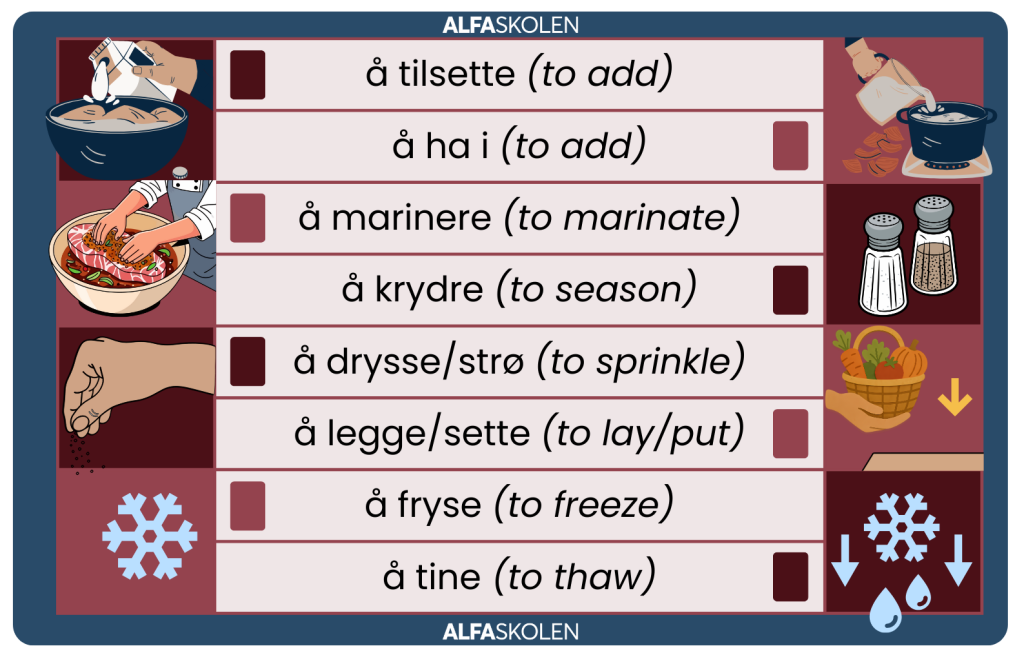
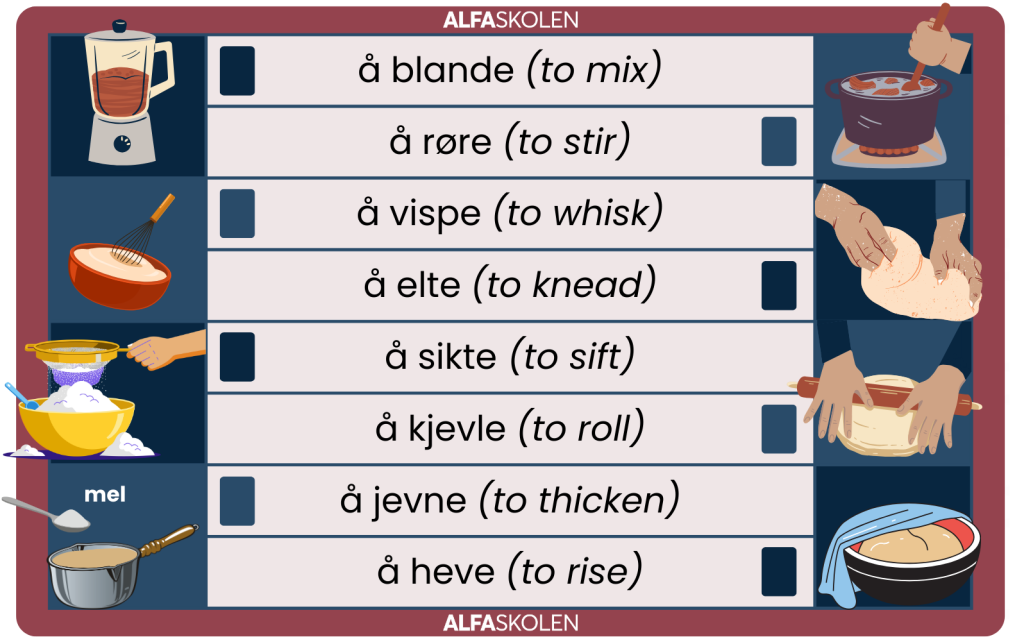
So what do these verbs that we often use in cooking actually mean? Many of them have multiple meanings. Some meanings are specific to cooking, while the verbs may have other meanings in different contexts. Here is a list of some common verbs we frequently use, along with their English translations:
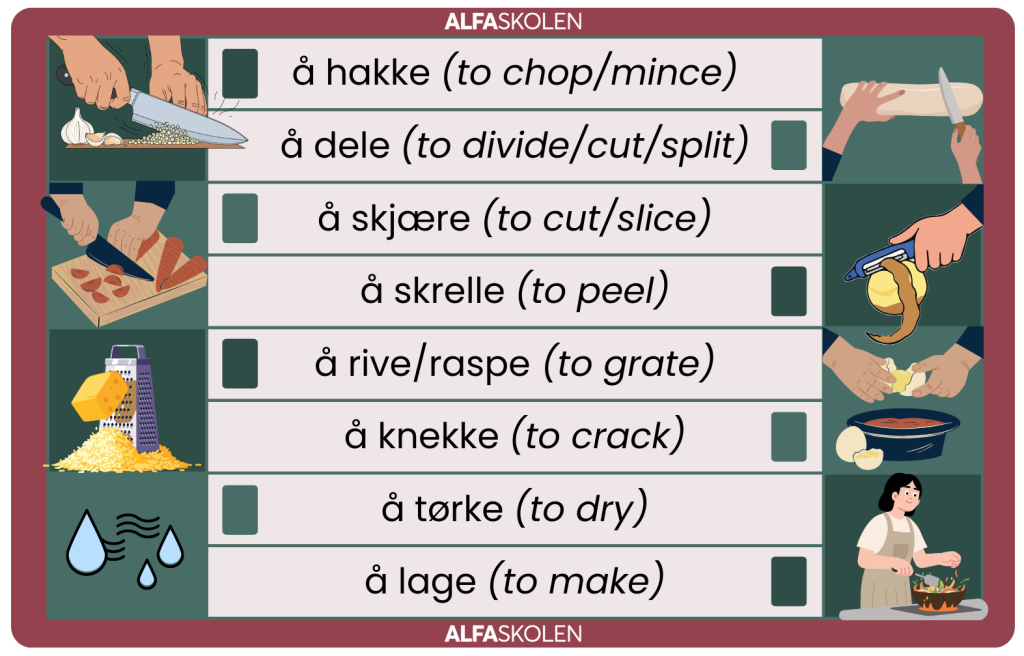
Show text version here:
| å smake (to taste) | å tilsette (to add) | å blande (to mix) | å koke (to boil) | å hakke (to chop/ mince) |
| å smelte (to melt) | å ha i (to add) | å røre (to stir) | å steke (to fry/bake) | å dele (to divide/cut/ split) |
| å helle (to pour) | å marinere (to marinate) | å vispe (to whisk) | å frityrsteke (to deep fry) | å skjære (to cut/slice) |
| å pensle (to brush) | å krydre (to season) | å elte (to knead) | å brune (to brown) | å skrelle (to peel) |
| å øke (to raise/ increase) | å drysse/strø (to sprinkle) | å sikte (to sift) | å trekke (to simmer) | å rive/raspe (to grate) |
| å senke (to lower) | å legge/sette (to lay/put) | å kjevle (to roll) | å bake (to bake) | å knekke (to crack) |
| å sile (to strain) | å fryse (to freeze) | å jevne (to thicken) | å dampe (to steam) | å tørke (to dry) |
| å skylle (to rinse) | å tine (to thaw) | å heve (to rise) | å riste (to shake/toast) | å lage (to make) |
We also need to look at some typical kitchen utensils/ equipment that we often use and that are useful to know the names of:
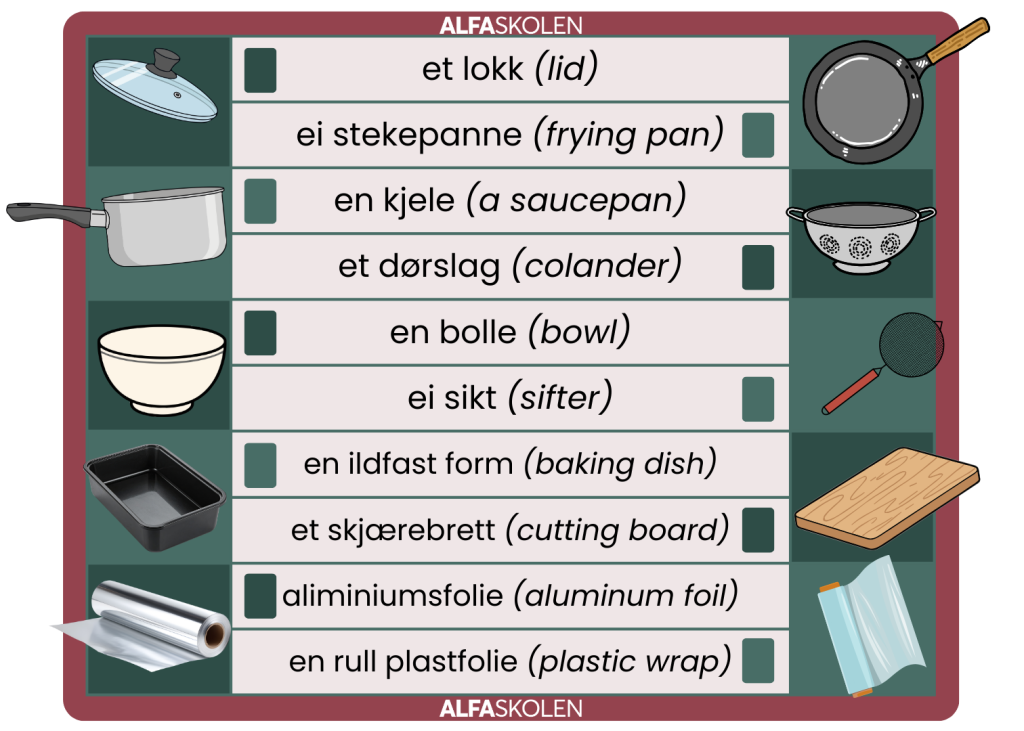
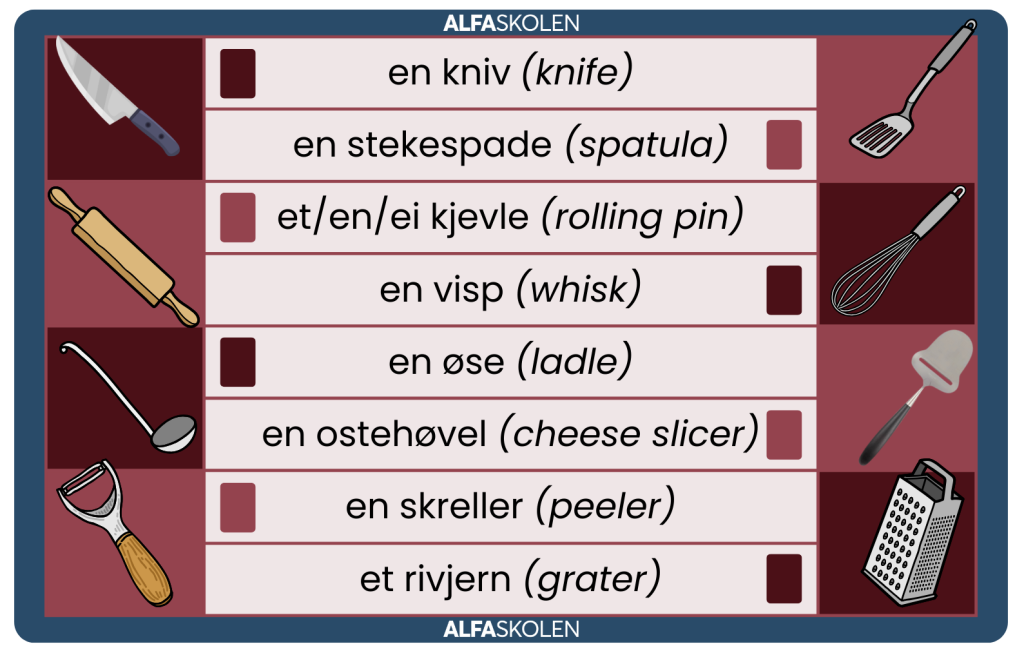
Show text version here:
| et lokk (lid) | en ildfast form (baking dish) | et/en/ei kjevle (rolling pin) |
| ei stekepanne (frying pan) | et skjærebrett (cutting board) | en visp (whisk) |
| en kjele (a saucepan) | aliminiumsfolie (aluminum foil) | en øse (ladle) |
| et dørslag (colander) | en rull plastfolie (plastic wrap) | en ostehøvel (cheese slicer) |
| en bolle (bowl) | en kniv (knife) | en skreller (peeler) |
| ei sikt (sifter) | en stekespade (spatula) | et rivjern (grater) |
Are you ready to follow a recipe in Norwegian now? Here, you can first take a look at a pizza recipe:
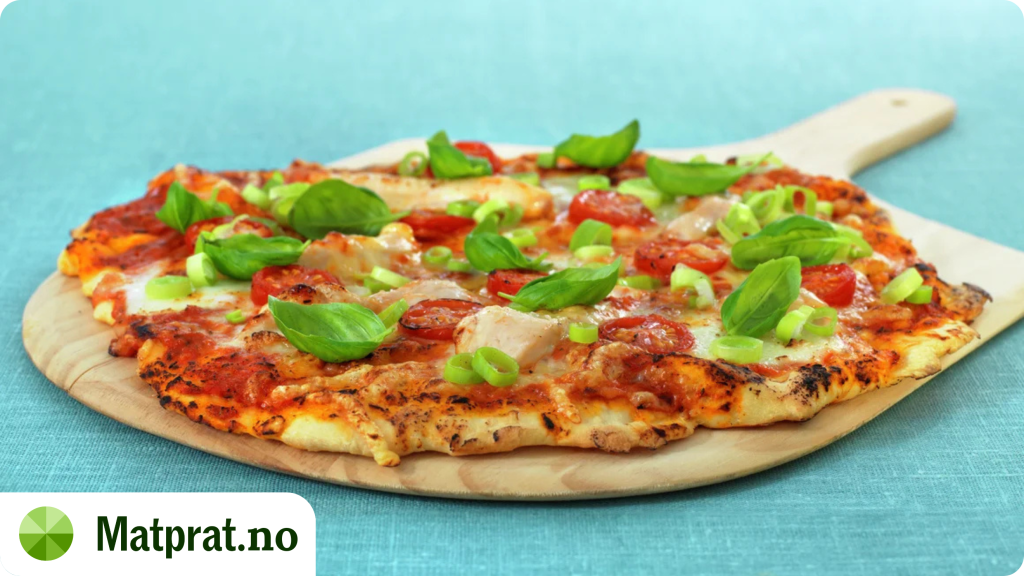
Italiensk pizza med kylling og mozzarella – MatPrat
If you felt that this went well and you’re still not full, you can try making Norway’s national dish—fårikål! It consists of mutton, cabbage, potatoes, salt, and pepper. You can also add a bit of flour if you want a thicker sauce. The word et får means the same as en sau (sheep), so the dish’s name is actually very self-explanatory (sheep in cabbage).😊 It has very few ingredients, but it is a very popular and warming dish during the autumn months of October and November:
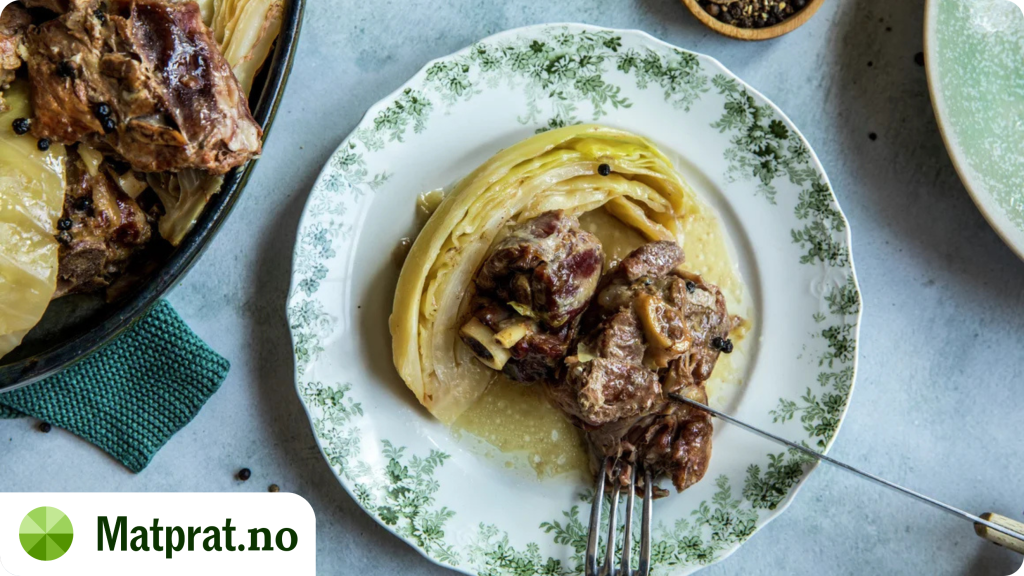
Fårikål | Oppskrift og video – MatPrat
If you’ve now made fårikål and actually liked it, you might feel a little more Norwegian. Maybe. But it’s important to remember that today’s Norway is influenced by many trends and hypes from abroad— from different countries and cultures. Nowadays, many people have different dietary preferences or needs, such as low-carb, vegetarian, vegan, pescatarian, gluten-free, or lactose-free. This impacts recipes and leads to new variations of existing dishes. What’s most popular can change overnight. Today, it might be poke bowls, ramen noodles, tacos, or tapas. Tomorrow, it could be something completely different.
That’s what makes food so exciting — we can constantly change it and come up with new variations, ingredients, or methods for preparing it. At Alfaskolen’s courses, we introduce cooking as a theme as early as at the A1 level, where you get a homework assignment to write a recipe in Norwegian, already making use of the imperative form and different measurements.
We wish you the best of luck with understanding Norwegian recipes and with your cooking adventures in the kitchen! 🍽️😊
Written by Gunnstein Husa / Teacher at Alfaskolen
Tags: